The Handover: How Shift-Change Communication Prevents Outages
Most on-air mistakes don't start at the equipment. They start at the moment one shift hands the room to the next. Here is how a good handover works, and why it is one of the most important leadership habits in a 24/7 team.


Every 24/7 team has a weak point that doesn’t appear on any equipment diagram: the few minutes when one shift leaves and another arrives. Knowledge that lived in one person’s head has to move into another’s, often when the first person is tired and the second hasn’t fully woken up.
In broadcast, that gap is where many problems begin. A feed that was “a bit unstable” at 2 a.m. becomes a frozen picture at 4 a.m. because the next operator never heard about it. I wrote about the operational side of this in Running an MCR like a high-reliability operation. This post is about the leadership side: why handovers fail, and how to build a team where they don’t.
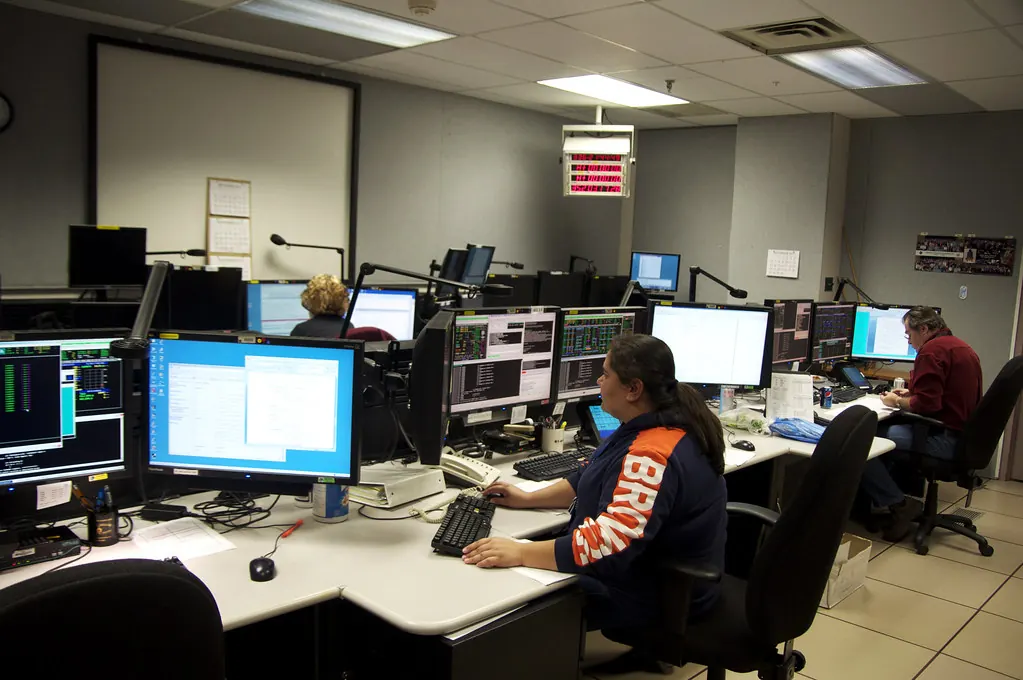
Photo: Hubble Space Telescope Control Room by NASA Goddard Space Flight Center, CC BY 2.0, via Flickr.
Why handovers fail
Handovers rarely fail because people are careless. They fail because:
- The outgoing person is tired and wants to leave.
- “Nothing happened” feels like nothing to say, so small warning signs are skipped.
- Information lives in many places: a log book, a WhatsApp message, a sticky note, someone’s memory.
- The incoming person doesn’t ask, because asking can feel like doubting a colleague.
None of these are technical problems. They are communication and culture problems, which makes them leadership problems.
What a good handover contains
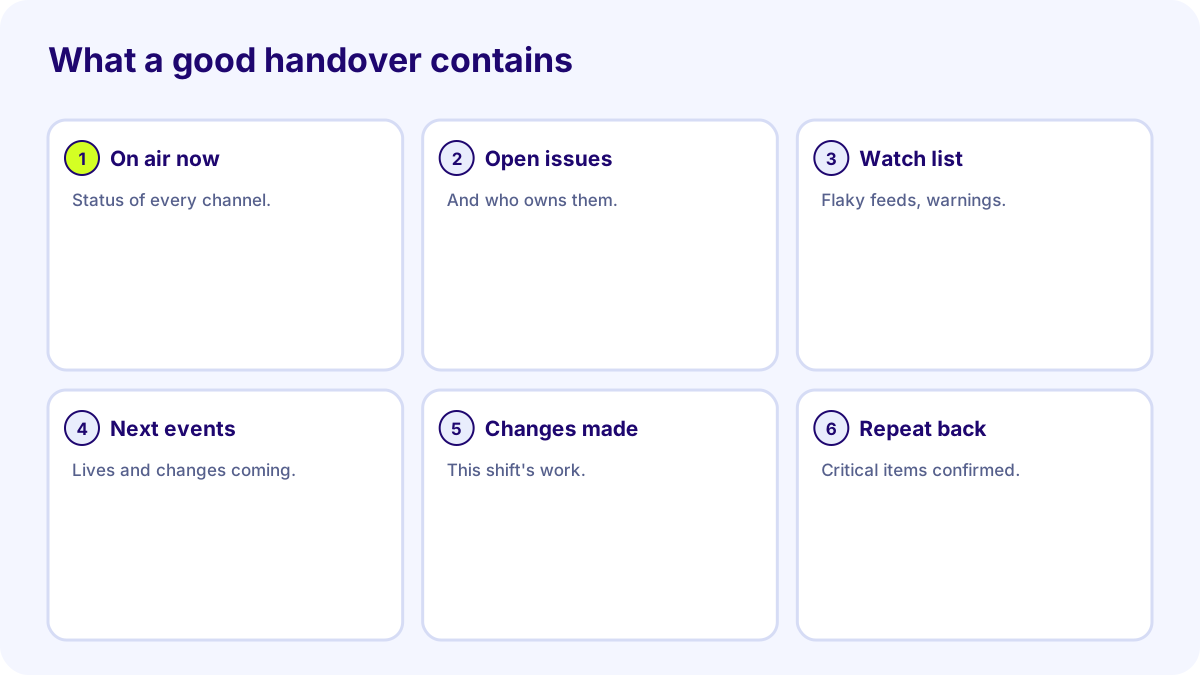
A useful handover answers the same questions every time, in the same order:
- Current state. What is on air right now, on which path, main or backup?
- Open issues. Anything unstable, unusual or “probably fine”.
- Changes made. What was switched, restarted, reconfigured or tested this shift?
- What’s coming. Live events, schedule changes, maintenance windows, special programmes.
- Who to call. Which engineer or vendor is involved in an open issue.
Writing these five headings on a shared sheet or form turns a handover from a casual chat into a structured transfer. The structure protects tired people from their own memory.
Talk and write
A written log alone isn’t enough, and a conversation alone isn’t enough either.
- Writing creates a record that survives the shift and can be checked later.
- Talking lets the incoming person ask questions and hear the tone: “it’s fine” said with a frown means something different from “it’s fine” said with a smile.
The best handovers I’ve seen are short, face to face, and walk through the written log together.
The incoming person owns the questions
A rule I like: the handover isn’t finished until the incoming person says it is. That small shift in ownership changes behaviour. The person arriving is responsible for understanding, so they ask. The person leaving is responsible for answering, so they don’t rush off.
As a leader, you make this safe by asking questions yourself, publicly, even when you think you know the answer. When senior people ask “just to confirm”, juniors learn that questions are normal, not an insult.
Repeat back the critical items
Borrowed from aviation and healthcare: for anything that could affect air, the incoming operator repeats it back. “So the backup encoder is on the spare input, and the live programme at 8 needs the second return feed.” It takes ten seconds and catches misunderstandings while they are still harmless.
Handovers between teams, not just shifts
The same idea applies wherever work changes hands:
- From the scheduling team to master control before a special broadcast.
- From engineers to operators after maintenance.
- From a designer to a developer when a brand system goes into an app.
- From one event volunteer team to the next on a long programme day.
Wherever ownership moves, information can fall through the gap. A short, structured handover with a chance to ask questions closes it.
How to introduce better handovers in your team
If your team’s handovers are informal today, don’t try to fix everything in one meeting:
- Agree on the five headings above, or your own version.
- Put them in one place, such as a shared sheet, a form or a printed log.
- Model it yourself on every shift you work.
- Praise good handovers out loud, especially when a small note prevented a bigger problem.
- Review after incidents: was the problem mentioned at handover? If not, why not?
Good handovers are invisible on a normal day. On a bad day, they are the reason the next shift already knows where to look.
Summary
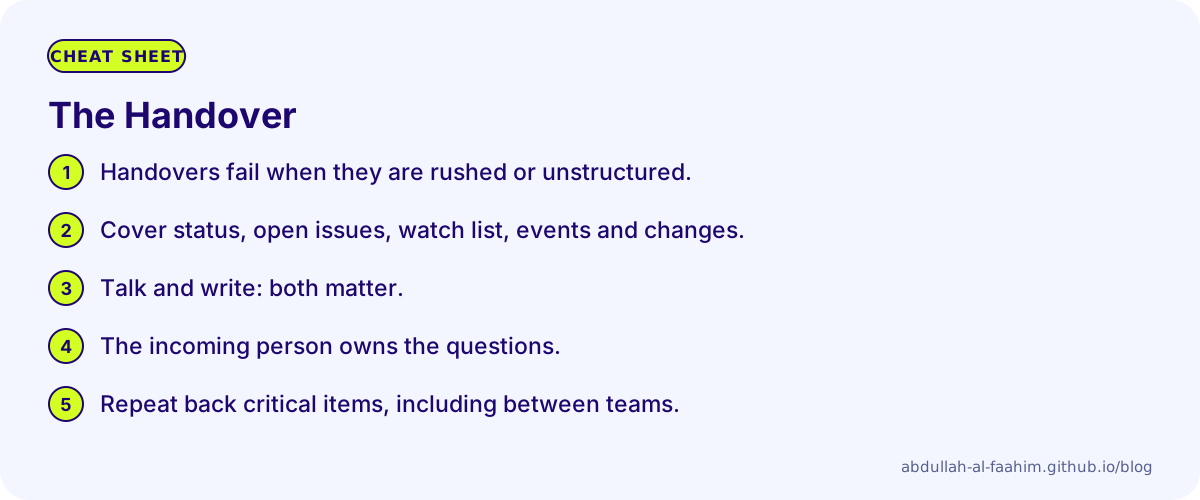
- Handovers fail when they are rushed or unstructured.
- Cover status, open issues, watch list, events and changes.
- Talk and write: both matter.
- The incoming person owns the questions.
- Repeat back critical items, including between teams.
Broadcast engineer at Channel i, brand and social media designer, and maker of offline-first apps for Bangladesh.
See my work