The Week Nusrat Said Yes to Everything
Nusrat is the designer who never says no: to her boss, to the sales team, to her cousin's wedding card. Then one Thursday night in Banani, everything she promised comes due at once. A Friday story about the overcommitment trap.

A Friday story. The people and places are fictional; the lessons are real.
Nusrat had a reputation at the agency: if you needed something, ask her. She would always say yes.
It was a good reputation to have, at first. At 27, two years into her job as a graphic designer at a mid-sized ad agency in Banani, Nusrat Jahan was the person everyone liked. The sales team liked her because she never refused a “small favour”. Rafiq bhai, the creative director, liked her because she never complained. Even the office peon, Jalil, liked her, because she once designed his daughter’s school science-fair poster on a Friday.

Photo by 16391475 on Pixabay (Pixabay Content License).
Sunday: five small yeses
On Sunday morning, before her first cup of tea had cooled, the requests began.
“Nusrat, just one Facebook post for the bank client? Ten minutes,” said Kamal from sales.
“Apu, can you check my layout before Rafiq bhai sees it?” asked Shuvo, the new junior.
“Nusrat, we need someone for the pitch deck on Wednesday. You’re good with decks,” said Rafiq bhai, already walking away.
Her phone buzzed: her cousin Ritu, getting married in December, needed a wedding card design “whenever you’re free, no hurry.”
And her main project, the packaging redesign for a tea brand, was due Thursday.
Yes. Yes. Of course. No problem. Sure, apu.
Wednesday: the bill arrives
By Wednesday, the ten-minute Facebook post had taken three rounds of changes. Shuvo’s “quick check” became a two-hour redesign. The pitch deck ate her whole Tuesday. Ritu had sent four reference images and a voice note.
The tea packaging, the project she would actually be judged on, sat untouched.
On Wednesday night, Nusrat left the office at 10:40 p.m. The Metro Rail was nearly empty. She opened her laptop on her knees and kept working until Mirpur 10.
Thursday: the deadline
At 4 p.m. on Thursday, the tea brand’s marketing manager called Rafiq bhai. “Where are the packaging options?”
Rafiq bhai walked to Nusrat’s desk. She had two half-finished options and red eyes.
“Why didn’t you tell me you were overloaded?” he asked, quietly.
“You asked me to do the deck,” she said.
“I asked. You could have told me what it would cost.”
Friday: tea at Karim chacha’s stall
On Friday afternoon, Nusrat met her university friend Mitu at Karim chacha’s tea stall near Mirpur 10. Mitu freelanced, and had learned the hard way how to protect her time.
“You don’t say no,” Mitu said, stirring her tea. “So nobody knows what’s really on your plate. Not even you.”
She took a napkin and wrote three questions:
- Does this help my main work, or my team’s?
- Do I really have the time, without stealing it from something more important?
- Am I the right person, or just the nearest person?
“If any answer is no,” Mitu said, “you don’t have to refuse. You negotiate.”
What Nusrat learned
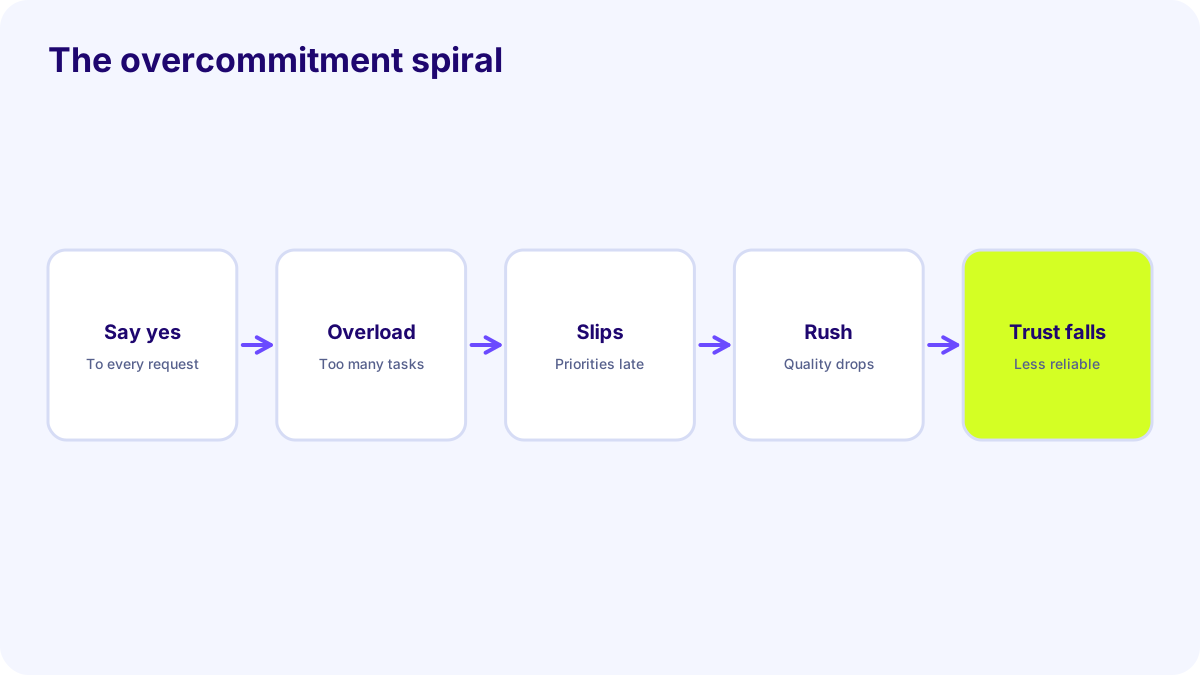
The next Sunday, Kamal from sales came by with another “ten-minute” post.
“I can do it Tuesday,” Nusrat said, “after the tea packaging is approved.”
When Rafiq bhai asked about another deck, she said: “I can do the deck or finish the packaging revisions this week. Which matters more?”
He looked surprised. Then he nodded. “Packaging. I’ll ask Shuvo to start the deck, and you review it.”
Nobody was angry. If anything, people seemed to trust her more. Her yes, it turned out, was worth more now that it wasn’t automatic.
Try this week
List everything you’ve agreed to in the last two weeks. Mark each one: important, nice to do or shouldn’t be mine. Renegotiate one item from the last list, using “yes, if…”, “not now”, “here’s who can” or “which one first?”
Summary
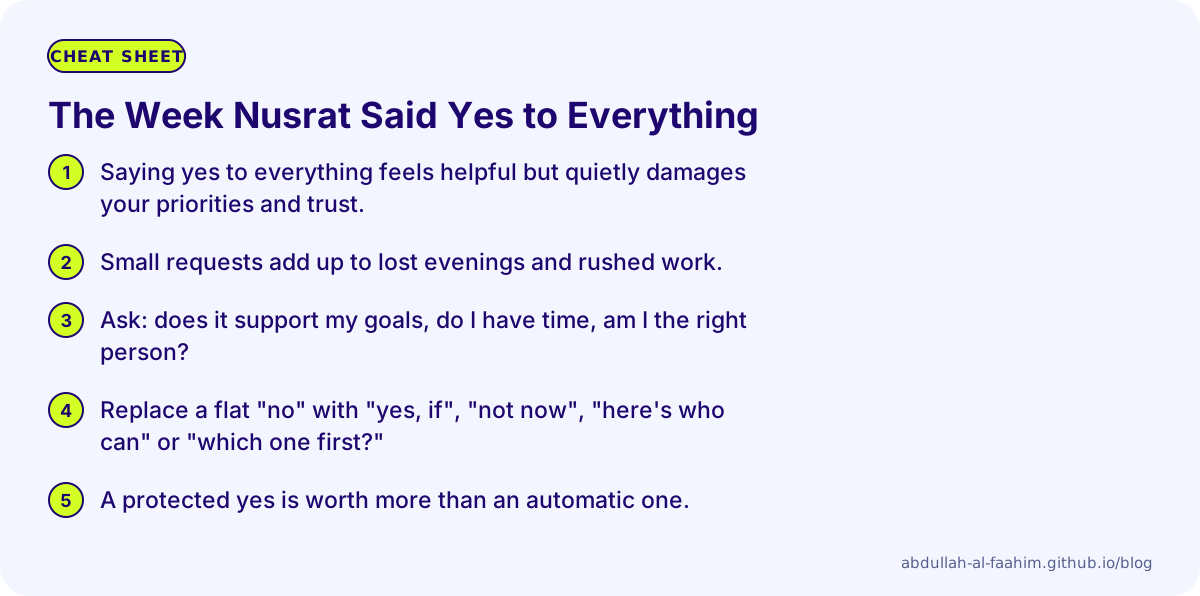
- Saying yes to everything feels helpful but quietly damages your priorities and trust.
- Small requests add up to lost evenings and rushed work.
- Ask: does it support my goals, do I have time, am I the right person?
- Replace a flat “no” with “yes, if”, “not now”, “here’s who can” or “which one first?”
- A protected yes is worth more than an automatic one.
Broadcast engineer at Channel i, brand and social media designer, and maker of offline-first apps for Bangladesh.
See my work